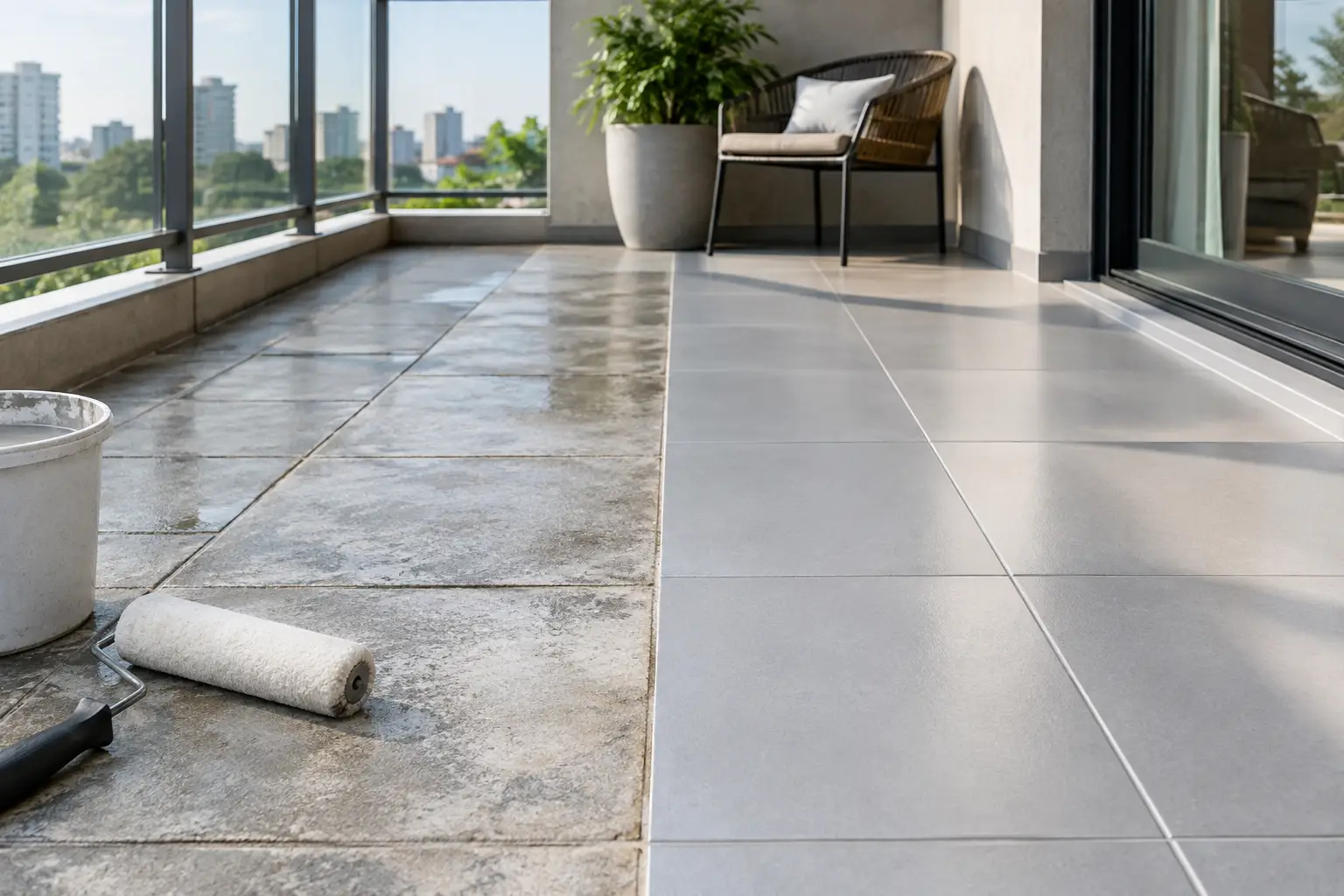
A leaking balcony rarely starts with a dramatic puddle. More often, it shows up as cracked grout, darkened joints, loose silicone at the wall edge, mould near a doorway or a stain appearing on the ceiling below. When comparing balcony resealing versus retile options, the key question is not which repair sounds more comprehensive. It is whether the existing tiles and waterproofing system can still be protected without unnecessary demolition.
For many Melbourne properties, targeted resealing and regrouting can stop water entering through failed surface joints while retaining sound tiles. In other cases, water has already damaged the membrane, screed or structure beneath the tiles, and a full strip-out is the safer long-term repair. A proper inspection separates these situations before you spend money on the wrong solution.
What balcony resealing actually fixes
Balcony resealing is a targeted repair for tiled balconies where the surface has deteriorated but the tiled base remains stable. It generally involves removing failed grout from tile joints, cleaning and preparing the area, applying new grout, and renewing flexible silicone joints where the balcony meets walls, door frames, balustrade posts or other fixed surfaces.
These perimeter and movement joints matter because balconies expand and contract with Melbourne's changing weather. Grout is not designed to flex. Where tiles meet a wall or threshold, silicone provides the flexible seal that helps keep water out of the gaps. Once that silicone splits, shrinks or detaches, rainwater can find a direct path below the tiled surface.
Resealing is often suitable when the tiles are firmly bonded, the balcony falls correctly towards the drain or outer edge, and the leak is caused by failed grout or silicone rather than a failed membrane. It can restore the finish, reduce water ingress and avoid the noise, dust, rubbish and cost of removing tiles.
It is not simply a cosmetic grout refresh. For a balcony leak repair to last, deteriorated materials must be properly removed and replaced, not covered with a surface product that may crack or peel away after a few wet months.
Balcony resealing versus retile options: the practical difference
The main difference is the depth of work. Resealing retains the existing tiled surface and addresses failures at the joints and edges. Retiling usually means removing some or all tiles, assessing the substrate, replacing or repairing waterproofing where needed, then laying and grouting new tiles.
Retiling can be the right option, but it is naturally more invasive. It may involve demolition, disposal, longer access restrictions and the risk of disturbing adjoining finishes. On apartment balconies, there can also be strata approval requirements, rules around waterproofing work and concerns about water reaching neighbouring lots below.
A full retile is generally justified when tiles are loose, hollow, cracked across multiple areas, poorly sloped, or when the waterproof membrane beneath has failed. Removing and replacing tiles without correcting a membrane problem does not solve the underlying issue. Equally, regrouting over a balcony with a failed membrane may improve its appearance but will not reliably stop water damage.
The most cost-effective option is therefore the one that matches the cause. If sound tiles can be retained and surface joints are the issue, resealing is usually the lower-disruption path. If moisture has compromised the system below, investing in a proper rebuild can prevent repeat repairs and more expensive damage later.
Signs a targeted reseal may be enough
A balcony may be a good candidate for resealing when the damage is localised and the tiles remain secure. Common signs include powdery, cracked or missing grout; silicone that has pulled away from edges; minor staining around joints; and water tracking through a specific wall-to-floor junction.
You may also notice that leakage occurs only during wind-driven rain or after water sits against a particular edge. That pattern can point to a failed perimeter seal rather than widespread waterproofing failure.
A specialist should still check the balcony carefully. They will look at grout condition, silicone joints, tile movement, drainage, falls, door thresholds and visible signs of moisture around the balcony perimeter. The aim is to identify the entry point before recommending work.
When retiling and waterproofing are the better call
There are situations where resealing is not an honest solution. If tiles move underfoot, sound hollow across large sections, or have cracked because the base beneath them is unstable, the balcony may need to be opened up. Water may have already reached the screed, damaged timber framing or affected the ceiling and walls below.
Poor drainage is another warning sign. A balcony should direct water away from the building and towards its drainage point. If water pools regularly near a sliding door, wall or balustrade, new grout alone cannot correct the fall. The underlying surface may need rebuilding so water does not keep loading the same vulnerable areas.
Retiling is also more likely where the waterproof membrane has reached the end of its service life or was incorrectly installed. In these cases, the tiles need to come up so the membrane can be replaced and properly integrated with drains, upturns and thresholds.
This work costs more because it involves more than tiles. It may include demolition, substrate preparation, waterproofing, curing time, new tiles, adhesives, grouting and reinstatement of surrounding finishes. That is why an inspection before committing is worthwhile.
Cost, disruption and timing for Melbourne properties
Resealing is usually faster and less disruptive than a full retile because existing tiles stay in place. There is less demolition waste, fewer trades involved and less chance of needing to replace nearby finishes simply because they were disturbed during removal. For landlords and property managers, this can be especially useful where the balcony needs attention between tenancies or before a small issue becomes a complaint from the apartment below.
A retile has a broader budget range because every balcony differs. Tile removal can reveal hidden damage, and rectifying drainage or membrane defects can add work that is impossible to confirm from the surface alone. The cheapest quote is not always the best value if it does not allow for diagnosing and repairing the source of the leak.
Access also matters. Upper-level balconies, tight apartment access, occupied homes and body corporate requirements can affect timing and cost. A clear, fixed quote for a suitable targeted repair gives you certainty. If larger remedial work is required, you should be told why rather than being sold a reseal that cannot reasonably deliver the outcome promised.
Avoid the common short-term fixes
Applying sealant over old grout, patching one visible crack or running a bead of silicone over failed silicone can look tidy for a short time. It does not remove the compromised material underneath, and it can trap moisture or make later repairs harder to assess.
Likewise, a balcony coating may have a place in some systems, but it should not be treated as a universal answer. Coatings can change the appearance and slip resistance of tiles, require careful preparation and may not address failed joints, drainage problems or damage below the tiled surface.
The right repair begins with cause, not product. If water is entering through joints, renew the joints properly. If water is bypassing the tiles through failed waterproofing or poor construction, address that deeper defect.
Choose a repair based on evidence, not appearance
A clean-looking balcony is not necessarily watertight, and tired grout does not automatically mean a full retile is needed. The useful decision point is whether the existing tiled system is stable and whether the leak path can be stopped from the surface.
For Melbourne homeowners, investors and property managers, a free inspection can remove much of the guesswork. Mr. Regrout provides fixed quotes for suitable tile-preserving repairs and backs completed waterproof repair work with a 5-year waterproof warranty, giving owners a clear alternative to unnecessary renovation.
If your balcony is showing early signs of deterioration, arrange an assessment before the next sustained rain turns a joint repair into damage beneath the tiles.